Ninny Chess
Come for the Chess?
You have arrived at the Ninny Chess Club, a modest institution, established under the reign of Edward the Seventh, devoted to the Royal Game and the steady production of avoidable mistakes.
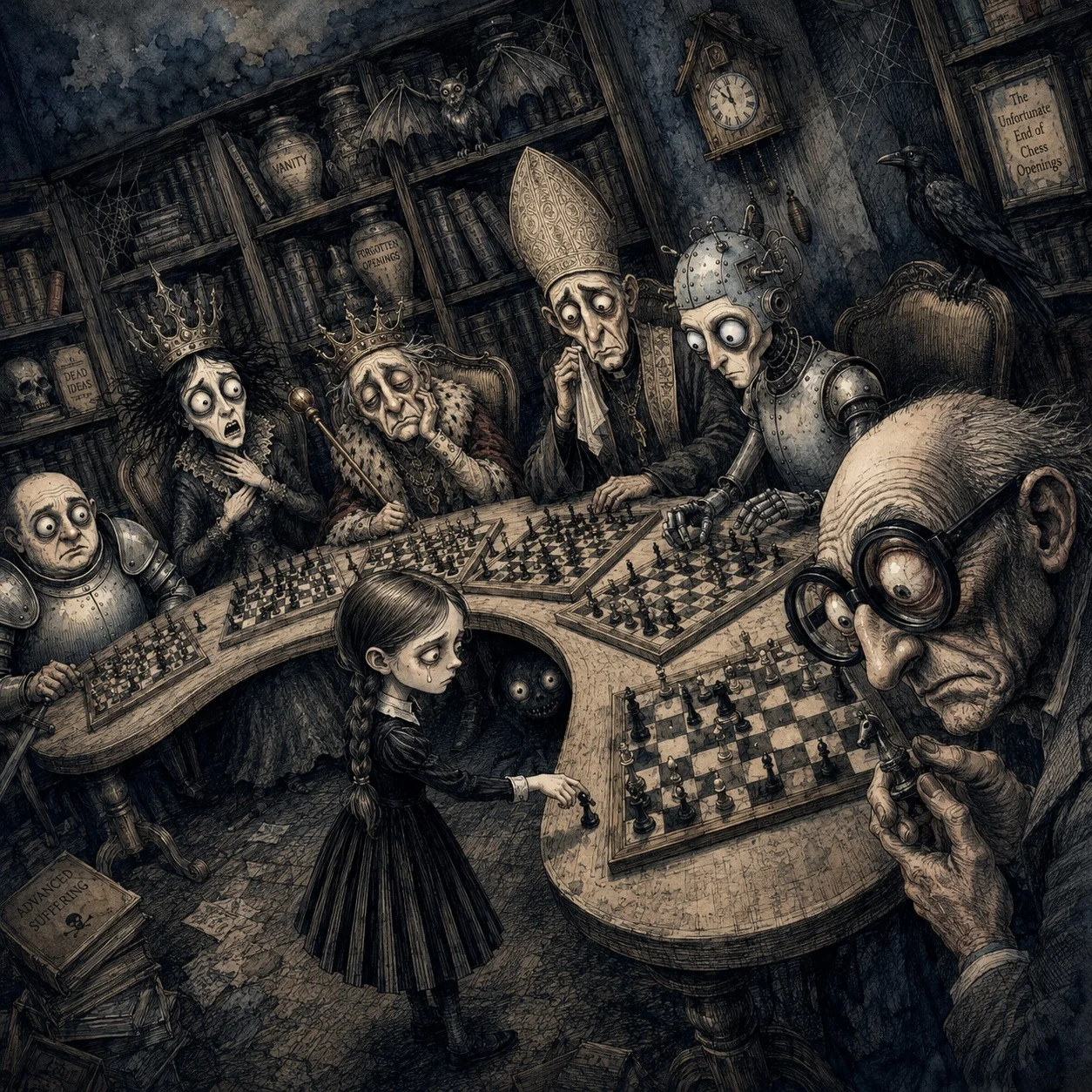
Outside these walls, earnest people insist that chess is the highest expression of human intellect. We have observed instead that it consists chiefly of shuffling carved bits of wood about until someone is politely asked to leave.
Our Esteemed Membership
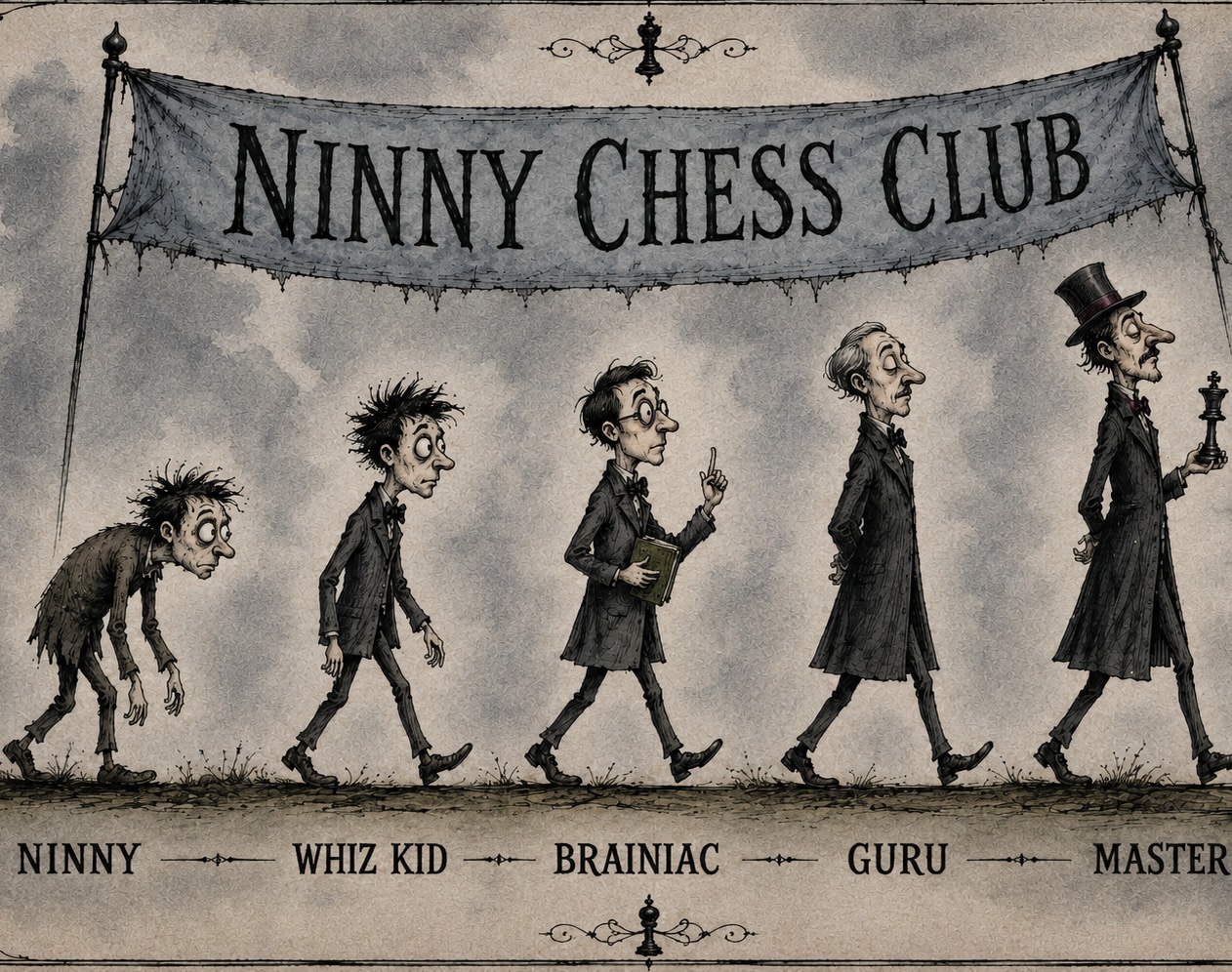
Our members are an agreeable sort. Failed inventors, disgraced wizards, poets of questionable merit, and retired villains, each with a distinct style and regrettable habits. Among them you will find opponents of every temperament, from aggressive attackers to stubborn defenders, all united by the fact that anyone can blunder or create a masterpiece, sometimes in the same game.
The haunted portraits along our walls were rendered by a tireless mechanical illustrator with no discernible soul. He is no Van Gogh, certainly, though a far better listener who never once complained about the light.
Requirements for Entry
We ask very little of new members.
- A working knowledge of the rules is appreciated, though by no means essential.
- An unreasonable confidence in one's own skill is strongly encouraged.
As our club handbook has long observed:
To err is human. To blunder on move three is simply good manners.
So do come in. Hang your optimism with your coat, accept a cup of Earl Grey, and take whichever chair appears least haunted.
There is always another game waiting.
THE CLUB'S AMENITIES
(for those who prefer their particulars in writing)
Eight opponents of genuine character. Each member plays in his own style, keeps his own opening repertoire, and reacts as the game turns with mutterings and the occasional excuse. Full biographies provided, none flattering.
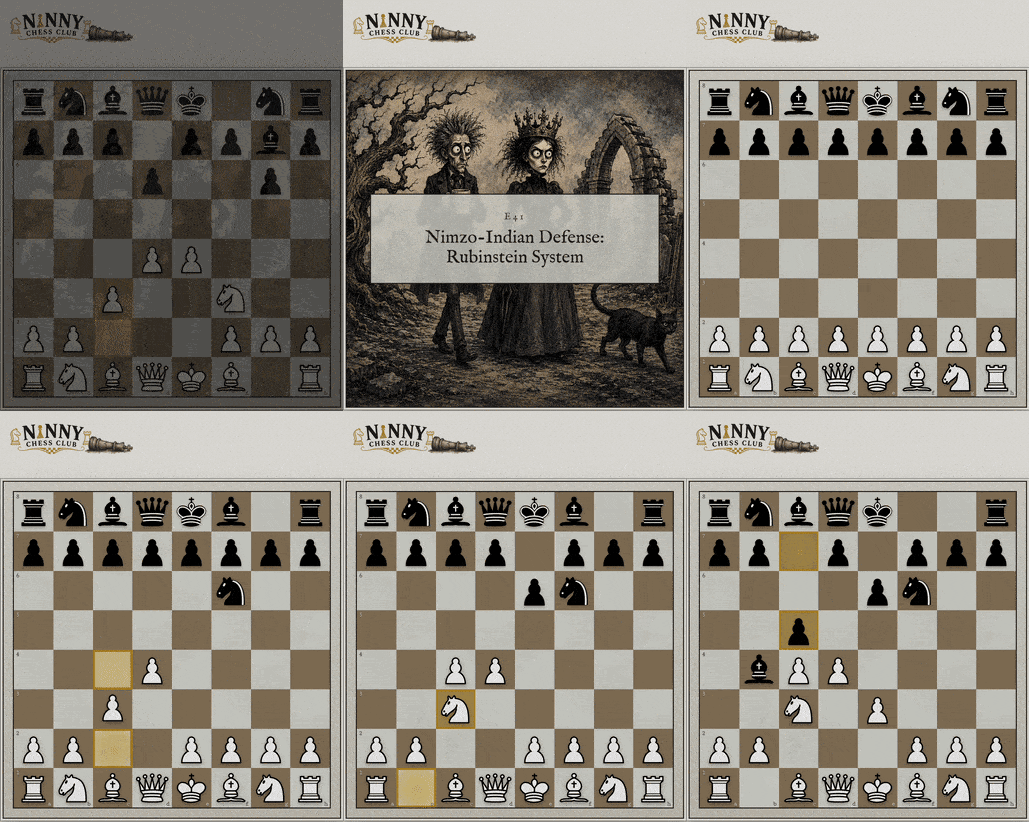
An Opening Theatre, performing continuously. An old-fashioned exhibition that plays itself: the classical openings demonstrated on the board and named as they go, interleaved with scenes of the membership at their leisure: study, tea, misadventure, and light haunting. Attendance is free.
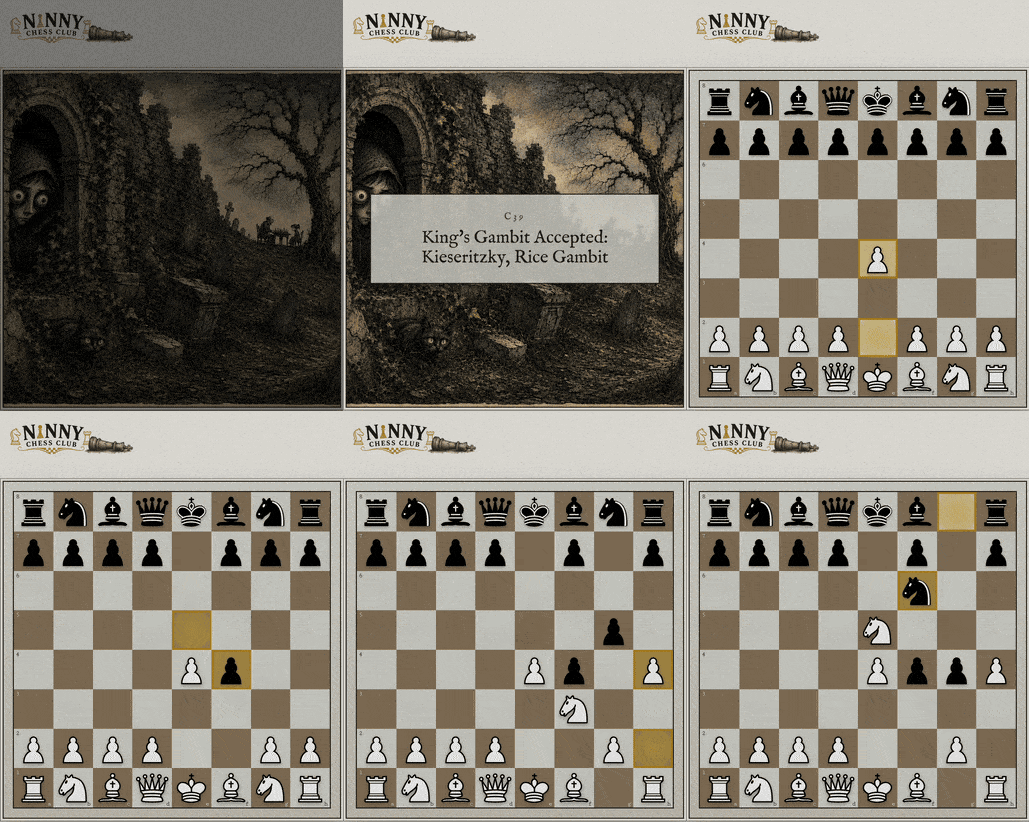
A Skittles Room. Observe the local eccentrics engaged in casual malice. Mind the draft, avoid the corner table, and try not to linger after dusk.
Six strengths, Beginner to Deadly. Each member offers whatever range his dignity permits. Some will happily play absolutely anyone, while others refuse to sit down below Club level.
Every opponent has blind spots. Weaker opponents may hang a piece outright. Stronger ones make subtle errors involving guards, pins, or overloaded defenders that take careful attention to uncover. Your part is to spot the mistake and deliver the decisive blow.
Handicap odds, in the old style. Arrive at the board unproven and your opponent might offer to remove his own queen, rook, or knight (or grant you pawn and move) before play begins. Earn his respect and he might play you straight next time.
A trophy case for every rivalry. Six trophies per member, pawn through king, one for each strength defeated. You get silver for wins at odds, gold for level terms. Complete an opponent's full range to prove your mastery.
A proper post-mortem. Optional review of every game with an evaluation bar, best move arrows, and engine lines you can click to explore on the board. Tactical moments are flagged for inspection.
Hints with discretion. Ask once for a nudge, twice for a direction, three times for the answer. An optional lamp flickers when a tactical opportunity is on the board, for members who prefer to be told.
Civilised conveniences. Timed or untimed play, take-backs (if your conscience permits), annotated PGN export, FEN grab, and games that survive a closed tab. The club will offer to resume where you left off after adjournment.